
The Personal MBA
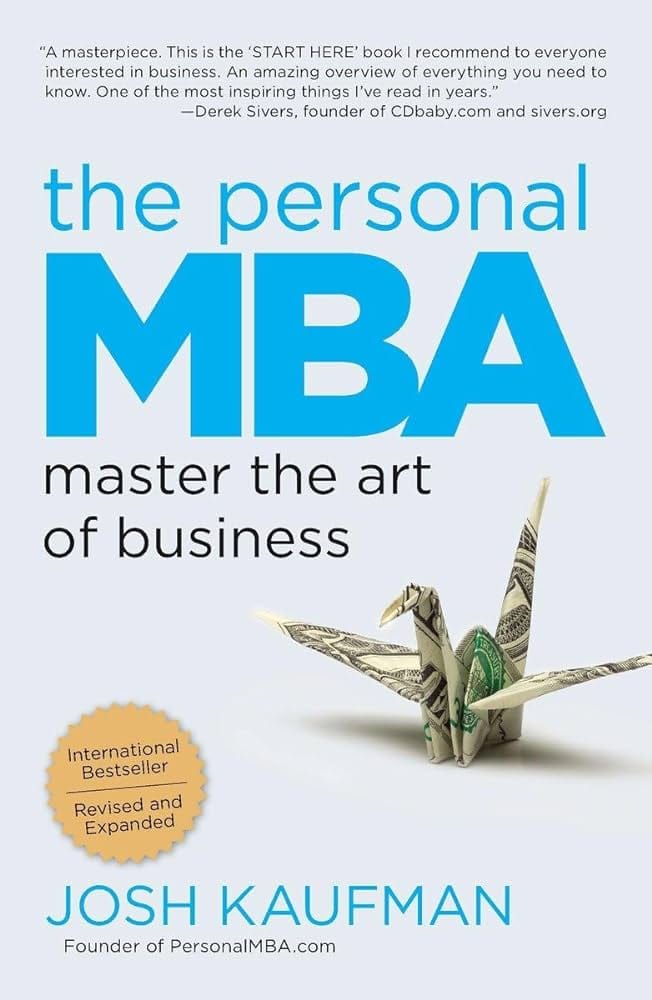
Overall Summary
Josh Kaufman's The Personal MBA argues that you don't need an expensive business school education to understand how business works. The book distills hundreds of essential business concepts into accessible mental models that anyone can learn and apply. Kaufman contends that traditional MBA programs often teach outdated theory, focus excessively on case studies of large corporations, and leave graduates with massive debt but limited practical skills.
The core insight is that business, despite its apparent complexity, operates on universal principles. Every successful business must create something valuable, attract attention and build demand, close sales, deliver on promises, and manage money effectively. These five processes form an interconnected system, and weakness in any area limits the whole.
Kaufman organizes his mental models around these five core processes plus additional sections on human psychology, productivity, and systems thinking. Rather than providing step-by-step instructions, he offers conceptual tools that help readers analyze situations, identify opportunities, solve problems, and make better decisions.
The book emphasizes that business fundamentally concerns human beings. Understanding cognitive biases, motivation, social dynamics, and decision-making patterns is not optional but essential. Kaufman draws heavily from behavioral economics and psychology to explain why people buy, how they evaluate options, and what drives their behavior.
Beyond the core business processes, Kaufman addresses personal effectiveness and working with yourself. He argues that understanding your own mind, managing your energy, and developing good habits are prerequisites for business success. The most brilliant strategy fails if you lack the discipline and focus to execute it.
The book serves as both introduction and reference, designed to be read cover-to-cover initially and then consulted as specific situations arise. Each concept receives a concise explanation with practical applications, making the content immediately useful rather than purely theoretical.
High-Level Overview: Key Arguments and Goals
The Anti-MBA Thesis: Traditional MBA programs are overpriced, time-consuming, and often fail to teach practical business skills. Self-education through deliberate study can provide equivalent or superior business knowledge at a fraction of the cost.
Mental Models as Foundation: Business is not infinitely complex. It operates on a finite set of universal principles and mental models that, once understood, can be applied across virtually any industry or situation.
The Five Parts of Every Business: Every business, regardless of size or industry, consists of five interdependent processes: Value Creation, Marketing, Sales, Value Delivery, and Finance. Mastery requires understanding how each part works and how they connect.
Systems Thinking: Businesses are complex systems with feedback loops, constraints, and emergent properties. Effective business decisions require understanding how changes in one area ripple through the entire system.
Human Psychology as Business Foundation: Business is fundamentally about people. Understanding how humans think, decide, and behave is essential for creating value, marketing effectively, selling successfully, and building functional organizations.
The Self-Education Imperative: Continuous learning and skill acquisition are more valuable than credentials. The most successful businesspeople are voracious autodidacts who never stop expanding their mental toolkit.
Part I: Value Creation
The Foundation of Business
Value creation is where every business begins. If you're not creating something people want, nothing else matters. Kaufman identifies twelve standard forms of value: Product, Service, Shared Resource, Subscription, Resale, Lease, Agency, Audience Aggregation, Loan, Option, Insurance, and Capital.
Understanding these forms helps entrepreneurs recognize opportunities. Most successful businesses combine multiple forms. A gym offers a shared resource (equipment), service (training), and subscription (membership). Recognizing which forms you're offering clarifies your business model.
Core Human Drives
People buy to satisfy fundamental needs. Kaufman identifies five core human drives: the drive to acquire, the drive to bond, the drive to learn, the drive to defend, and the drive to feel. Every successful product or service connects to at least one of these drives. The more drives a product satisfies, the more attractive it becomes.
Evaluating Opportunities
Not all business ideas deserve pursuit. Kaufman provides evaluation criteria: urgency (how badly people need it), market size (how many people want it), pricing potential (what people will pay), cost of acquisition (how expensive it is to gain customers), cost of delivery (what it costs to provide), uniqueness (how different from alternatives), speed to market (how quickly you can launch), upfront investment (capital required), upsell potential (opportunities for additional sales), and evergreen potential (ongoing relevance).
Iteration and Feedback
Value creation is not a one-time event but an ongoing process. Kaufman emphasizes rapid iteration based on customer feedback. Rather than spending years perfecting a product in isolation, successful creators ship early versions and improve based on real-world response. The concept of "minimum viable product" appears here: the smallest offering that allows you to learn what customers actually want.
Part II: Marketing
Attention and Receptivity
Marketing is fundamentally about getting the attention of people who might want what you offer. Kaufman distinguishes between attention and receptivity. Grabbing attention is necessary but insufficient. People must also be receptive, meaning open to your message. Interrupting someone with unwanted marketing destroys receptivity even while capturing attention.
Effective Marketing Principles
Permission-based marketing (where people opt in to receive communications) outperforms interruption marketing. Building an audience over time creates assets that compound. Remarkability (being worth talking about) generates word-of-mouth that no advertising budget can buy.
Kaufman introduces the concept of "probable purchaser": the specific type of person most likely to buy. Rather than marketing to everyone, successful businesses identify and focus on their probable purchasers. This targeting reduces waste and increases effectiveness.
Framing and Positioning
How you present your offering dramatically affects perception. Framing provides context that shapes interpretation. The same wine tastes better when people believe it's expensive. Positioning establishes how your offering relates to alternatives. Are you the premium option? The budget choice? The specialist?
Kaufman emphasizes that marketing is not about manipulation but about connection. The goal is helping people who genuinely need what you offer understand that you exist and can help them.
Part III: Sales
The Transaction
Sales is where marketing converts to revenue. After attracting attention and building interest, you must close transactions. Kaufman frames sales as a helping relationship rather than adversarial combat. Good salespeople identify qualified prospects (people who need, want, and can afford the offering) and help them make good decisions.
Barriers to Purchase
Understanding why people don't buy is as important as understanding why they do. Common barriers include: lack of funds, lack of authority (the person can't make the decision), lack of trust (uncertainty about whether you'll deliver), lack of urgency (no compelling reason to act now), and lack of perceived relevance (they don't see how the offering helps them).
Effective sales systematically addresses these barriers. Building trust takes time and consistency. Creating urgency requires highlighting genuine costs of delay. Establishing relevance demands understanding the prospect's situation deeply enough to connect your offering to their specific needs.
Pricing
Price communicates value. Too low, and people question quality. Too high, and you exclude potential buyers. Kaufman discusses various pricing strategies: value-based pricing (based on what it's worth to the customer), cost-plus pricing (based on your costs), competitive pricing (based on alternatives), and dynamic pricing (adjusted based on demand).
The concept of "price sensitivity" varies by customer and context. Some buyers care primarily about price; others care primarily about quality, convenience, or status. Segmenting customers by price sensitivity allows sophisticated pricing strategies.
Part IV: Value Delivery
Fulfilling Promises
Value delivery is where you actually provide what customers purchased. This is where most businesses spend the majority of their time and resources. Kaufman emphasizes that value delivery must be predictable, consistent, and ideally better than expected. Under-promising and over-delivering builds trust and generates referrals.
The Value Stream
Kaufman introduces systems concepts for understanding delivery. The "value stream" is the sequence of steps that transforms raw inputs into delivered value. Mapping this stream reveals inefficiencies, bottlenecks, and opportunities for improvement.
Every value stream has a constraint, the limiting factor that determines throughput. Improving anything other than the constraint produces no overall improvement. Identifying and addressing constraints is the fastest path to increased capacity.
Quality and Throughput
Quality and speed often seem opposed, but Kaufman argues they're complementary at the systems level. Poor quality creates rework, delays, and customer complaints that reduce overall throughput. Investing in quality systems pays dividends through reduced waste and increased customer satisfaction.
Measurement matters for improvement. Kaufman advocates tracking key performance indicators (KPIs) that reveal how well the value stream is functioning. Without measurement, improvement is guesswork.
Part V: Finance
The Language of Business
Finance is how businesses keep score. Understanding financial concepts is essential for making good decisions, even if you're not personally managing the books. Kaufman covers fundamental concepts: revenue, expenses, profit, cash flow, assets, liabilities, and equity.
Profit margin (what percentage of revenue remains after expenses) indicates efficiency. Cash flow (actual money moving in and out) determines survival. Many profitable businesses fail because they run out of cash. Understanding the difference between profit and cash flow is crucial.
Financial Decision-Making
Every business decision has financial implications. Kaufman introduces concepts for evaluating options: opportunity cost (what you give up by choosing one option over another), time value of money (money now is worth more than money later), and return on investment (what you get back relative to what you put in).
Compounding is powerful in both directions. Returns compound when reinvested. But so do costs. Small inefficiencies become massive drains over time. Financial literacy helps identify which investments will compound favorably.
Funding and Capital
Kaufman discusses different approaches to funding. Bootstrapping (self-funding through revenue) preserves control but limits growth speed. External funding (debt or equity) enables faster scaling but introduces obligations and constraints.
Understanding leverage (using borrowed money to amplify returns) and its risks is essential. Leverage magnifies both gains and losses. Conservative leverage provides upside while limiting downside risk.
Part VI: The Human Mind
How We Think
Kaufman dedicates significant attention to psychology because business decisions are made by humans with predictable quirks. Cognitive biases, mental shortcuts, and emotional influences affect every decision. Understanding these patterns helps both in predicting others' behavior and in improving your own decisions.
Key biases include: loss aversion (losses hurt more than equivalent gains feel good), availability bias (overweighting easily remembered examples), confirmation bias (seeking evidence that supports existing beliefs), and anchoring (over-relying on initial information).
Motivation and Behavior
Understanding what drives behavior helps in designing products, managing people, and selling effectively. Kaufman discusses intrinsic motivation (doing something for its inherent satisfaction) versus extrinsic motivation (doing something for external rewards). Research shows intrinsic motivation produces better results for complex work.
Habits automate behavior. Understanding how habits form and change helps in building personal effectiveness and in designing products that become part of users' routines.
Part VII: Working with Yourself
Personal Productivity
Business success requires personal effectiveness. Kaufman addresses energy management, attention management, and habit formation. He argues that willpower is limited and unreliable. Better systems reduce reliance on willpower.
The concept of "monoidealism" (focusing on one thing at a time) counters the myth of multitasking. Deep, focused work produces better results than fragmented attention. Protecting time for focused work is essential.
Decision Making
Given uncertainty, how do we make good decisions? Kaufman advocates thinking probabilistically rather than seeking certainty. Most decisions are reversible; excessive deliberation wastes time. For irreversible decisions, more careful analysis is warranted.
Mental simulation (imagining scenarios) helps anticipate consequences. Pre-mortem analysis (imagining failure and working backward to identify causes) reveals risks that optimistic planning overlooks.
Part VIII: Working with Others
Communication and Collaboration
Most significant work requires collaboration. Kaufman discusses effective communication, team dynamics, and organizational structures. He emphasizes that communication often fails because we assume others understand what we mean. Explicit verification and feedback loops catch misunderstandings early.
Teams perform best with psychological safety (freedom to take risks without fear of punishment), clear goals, and appropriate autonomy. Micromanagement kills initiative; abandonment creates chaos. Finding the right balance requires ongoing adjustment.
Leadership and Management
Kaufman distinguishes leadership (setting direction and inspiring action) from management (organizing resources and monitoring progress). Both are necessary. Leadership without management produces vision without execution. Management without leadership produces efficiency without purpose.
Power dynamics shape organizations. Understanding how authority, influence, and incentives interact helps in navigating organizational complexity and designing better systems.
Part IX: Understanding Systems
Systems Thinking
Businesses are complex systems with interconnected parts, feedback loops, and emergent properties. Linear cause-and-effect thinking often fails because changes create unexpected consequences elsewhere in the system.
Kaufman introduces concepts like stocks (accumulations), flows (rates of change), feedback loops (reinforcing or balancing), and delays (time between cause and effect). These tools help in understanding system behavior and predicting consequences of interventions.
Analyzing Systems
To improve a system, you must first understand it. Kaufman recommends mapping system components and their relationships. Identifying feedback loops reveals what keeps the system stable or drives change. Finding leverage points (places where small changes produce large effects) enables efficient improvement.
Not all leverage points are equally accessible. Sometimes the highest-leverage intervention is politically or practically impossible. Effective systems thinking considers implementation constraints alongside theoretical effectiveness.
Conclusion: The Path to Mastery
The Personal MBA concludes by returning to its central argument: business mastery comes from understanding and applying fundamental principles, not from credentials or formal education. The mental models in the book provide a foundation, but true mastery requires application. Knowledge without practice remains theoretical.
Kaufman advocates continuous learning and deliberate practice. The business landscape evolves, and yesterday's insights become tomorrow's conventional wisdom. Staying ahead requires ongoing study and adaptation.
The book also emphasizes integration. Individual mental models are useful, but their power multiplies when combined. A deep understanding of human psychology enhances marketing, sales, leadership, and negotiation. Systems thinking applies to operations, finance, and strategy. The connections between concepts matter as much as the concepts themselves.
Finally, Kaufman reminds readers that business serves human purposes. Profit is a signal of value creation, not an end in itself. The most satisfying business success comes from genuinely helping people while building something sustainable. Technical mastery enables that purpose but cannot replace it.