
Financial Intelligence
Overall Summary
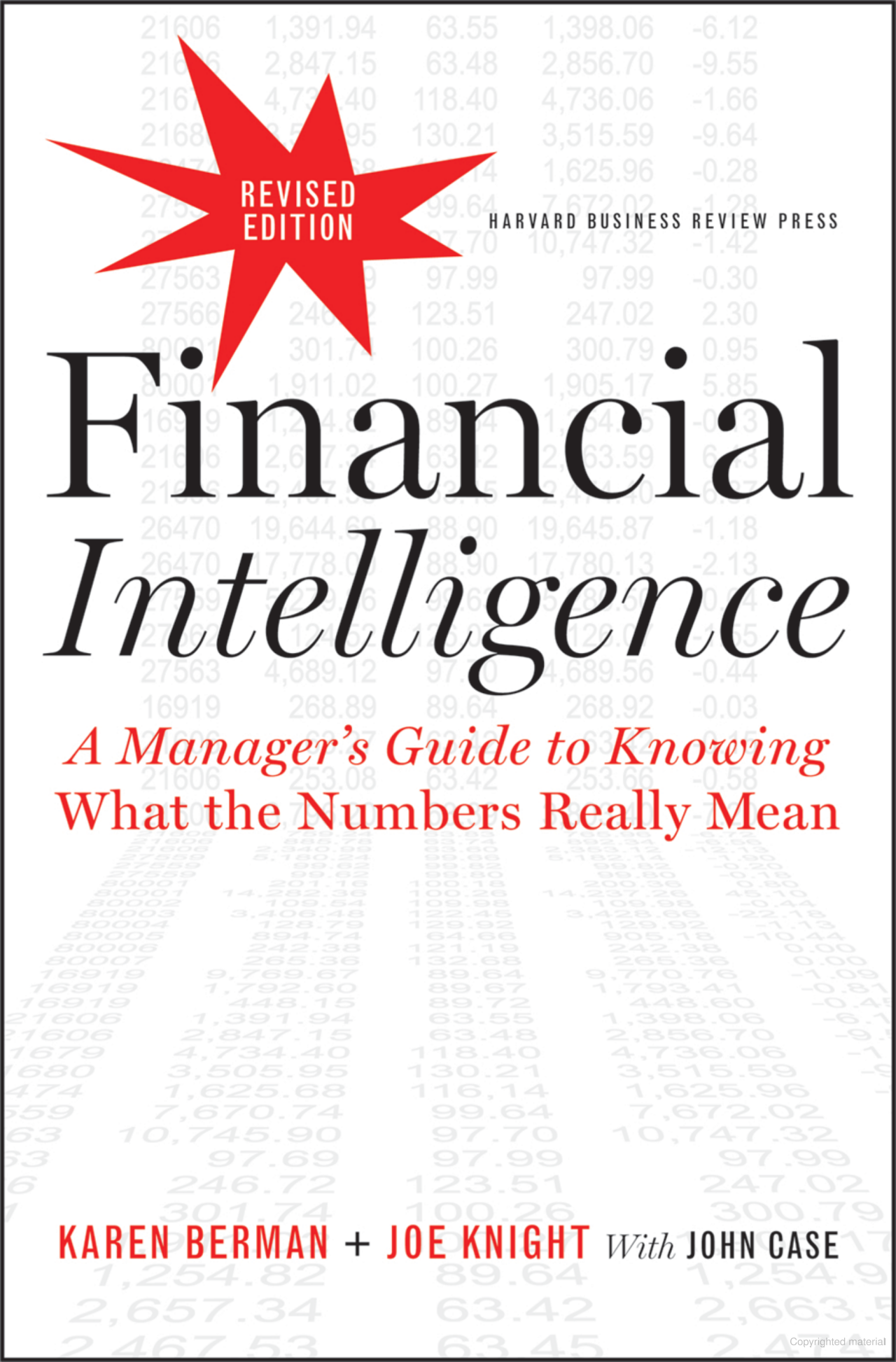
Karen Berman and Joe Knight's Financial Intelligence demystifies accounting and finance for non-financial managers who need to understand the numbers driving their organizations. The book's central premise is that financial literacy is not optional for managers; it's essential for making good decisions, communicating effectively with finance departments, and advancing in any organization.
The authors challenge the common assumption that financial statements represent objective truth. Instead, they reveal that accounting involves countless estimates, assumptions, and judgment calls. Understanding this "art of finance" alongside the science allows managers to ask better questions, interpret reports more accurately, and avoid being misled by numbers that appear more precise than they actually are.
The book walks readers through the three fundamental financial statements: the income statement, the balance sheet, and the cash flow statement. Rather than treating these as abstract accounting exercises, Berman and Knight explain what each line item means in practical terms, how the statements connect to each other, and why managers should care about specific metrics.
Beyond understanding statements, the book covers financial analysis tools that help managers evaluate performance, compare options, and make investment decisions. Concepts like return on investment, working capital management, and ratio analysis become accessible through clear explanations and real-world examples.
The authors emphasize that financial intelligence serves a practical purpose: helping managers contribute more effectively to their organizations. A manager who understands how their decisions affect profitability, cash flow, and asset utilization can make better choices and communicate those choices persuasively to senior leadership. Financial literacy transforms managers from passive recipients of budget constraints into active participants in financial conversations.
Throughout the book, Berman and Knight maintain an accessible tone, acknowledging that most readers approach finance with some anxiety. They use plain language, concrete examples, and a "tool kit" structure that allows readers to reference specific concepts as needed rather than requiring cover-to-cover reading.
High-Level Overview: Key Arguments and Goals
Finance as a Learnable Skill: Financial intelligence is not an innate talent or the exclusive domain of accountants. Any manager can develop sufficient financial literacy to interpret statements, analyze performance, and make informed decisions.
The Art of Finance: Accounting is not purely objective. Financial statements reflect numerous estimates, assumptions, and judgment calls. Understanding where subjectivity enters the numbers helps managers interpret them more accurately and ask better questions.
The Three Statement Framework: The income statement, balance sheet, and cash flow statement form an interconnected system. Each tells a different story, and understanding all three provides a complete picture of organizational financial health.
Cash vs. Profit Distinction: Profit and cash are fundamentally different concepts that confuse many managers. A company can be profitable while running out of cash, or cash-rich while losing money. Understanding this distinction is critical for survival.
Financial Analysis for Decision-Making: Ratios, return calculations, and working capital analysis are practical tools for evaluating performance and comparing options. These techniques help managers move beyond gut feeling to evidence-based decisions.
Managerial Application: Financial intelligence serves practical purposes: improving decisions, communicating effectively with finance teams, understanding how your actions affect the bottom line, and contributing meaningfully to organizational strategy.
Part I: The Art of Finance (and Why It Matters)
Financial Statements Are Not Reality
Berman and Knight open by challenging a fundamental misconception: that financial statements represent objective fact. In reality, creating financial statements requires countless judgment calls. When should revenue be recognized? How should inventory be valued? What's the useful life of equipment for depreciation purposes? Different answers to these questions produce different numbers, all of which may be technically correct.
This doesn't mean financial statements are unreliable or that accountants are manipulating numbers. It means that intelligent readers must understand the assumptions underlying the figures. Two companies in the same industry with identical operations might report different profits simply because they made different (but legitimate) accounting choices.
Why This Matters for Managers
Understanding the art of finance protects managers from naive interpretation. When someone presents a financial report as definitive proof of performance, a financially intelligent manager asks: What assumptions went into these numbers? Could different assumptions change the conclusion? This skepticism isn't cynicism; it's sophisticated reading.
The art of finance also explains why finance professionals sometimes seem evasive. When asked for a "simple" answer about profitability or value, accountants often respond with "it depends." They're not being difficult; they're acknowledging that the answer genuinely depends on assumptions that require judgment.
The Building Blocks
Before diving into statements, the authors establish foundational concepts. They distinguish between financial accounting (creating statements for external audiences like investors and regulators) and managerial accounting (creating reports for internal decision-making). They explain accrual accounting, which records revenues and expenses when earned or incurred rather than when cash changes hands. This accrual basis is what creates the gap between profit and cash that confuses so many managers.
Part II: The Income Statement
What the Income Statement Shows
The income statement (also called the profit and loss statement or P&L) answers a fundamental question: Did the company make money during this period? It shows revenues, subtracts various categories of costs and expenses, and arrives at net profit (or loss).
The basic structure flows from revenue through several profit levels. Gross profit equals revenue minus cost of goods sold (the direct costs of producing what was sold). Operating profit (or EBIT, earnings before interest and taxes) subtracts operating expenses like salaries, rent, and marketing. Net profit subtracts interest, taxes, and any other items to reach the bottom line.
Key Income Statement Concepts
Revenue Recognition: When does a sale become revenue? This seemingly simple question generates enormous complexity. If a software company signs a three-year contract, should all revenue appear immediately or be spread over three years? Different approaches dramatically affect reported performance.
Cost of Goods Sold (COGS): These are direct costs tied to production. For a manufacturer, COGS includes materials, factory labor, and factory overhead. For a retailer, it's the purchase price of inventory sold. What counts as COGS versus operating expense affects gross margin calculations.
Depreciation and Amortization: These non-cash expenses spread the cost of assets over their useful lives. A machine purchased for $100,000 might be depreciated over ten years, showing $10,000 expense annually. The cash left the company at purchase, but the expense appears gradually. This is a major reason profit differs from cash flow.
Operating Expenses: These costs keep the business running but aren't directly tied to production. Sales and marketing, research and development, general administration, and similar functions appear here. The line between COGS and operating expenses sometimes involves judgment calls.
The Art in the Income Statement
Berman and Knight highlight where subjectivity enters. Revenue recognition timing, depreciation schedules, inventory valuation methods, expense categorization, and provisions for bad debts all require judgment. Two accountants looking at identical transactions might produce legitimately different income statements.
This doesn't make the income statement useless. It means readers should understand the choices involved and consider how different assumptions would affect the numbers. Sophisticated users compare statements knowing that some differences reflect accounting choices rather than operational performance.
Part III: The Balance Sheet
What the Balance Sheet Shows
While the income statement covers a period (a quarter, a year), the balance sheet captures a moment in time. It shows what the company owns (assets), what it owes (liabilities), and the residual belonging to owners (equity). The fundamental equation always balances: Assets = Liabilities + Equity.
The balance sheet answers questions like: How much cash does the company have? How much do customers owe us? What's the value of our inventory and equipment? How much debt have we taken on? What have shareholders invested, and how much profit has been retained?
Assets: What the Company Owns
Current Assets are expected to convert to cash within one year. Cash itself tops the list. Accounts receivable represents money owed by customers. Inventory includes raw materials, work in progress, and finished goods. Prepaid expenses cover payments made in advance for future benefits.
Non-current (Long-term) Assets provide value beyond one year. Property, plant, and equipment (PP&E) encompasses land, buildings, machinery, and similar physical assets, shown at original cost minus accumulated depreciation. Intangible assets like patents, trademarks, and goodwill (the premium paid when acquiring another company) also appear here.
Liabilities: What the Company Owes
Current Liabilities come due within one year. Accounts payable represents money owed to suppliers. Short-term debt and the current portion of long-term debt appear here. Accrued expenses cover obligations incurred but not yet paid, like wages earned by employees before payday.
Non-current (Long-term) Liabilities extend beyond one year. Long-term debt (bonds, mortgages, term loans) dominates this section for most companies. Deferred tax liabilities and pension obligations may also appear.
Equity: The Owners' Stake
Shareholders' equity represents what would remain if the company sold all assets and paid all liabilities (theoretically). It includes capital contributed by shareholders (through stock purchases) plus retained earnings (accumulated profits not paid out as dividends). Equity grows when the company earns profits and retains them; it shrinks when losses accumulate or dividends are paid.
The Art in the Balance Sheet
Judgment permeates the balance sheet. How should inventory be valued when prices fluctuate? What's the useful life for depreciation calculations? How much should be reserved for customers who won't pay? Is goodwill from an acquisition still worth its recorded value, or should it be written down?
The balance sheet also excludes significant assets that accountants can't reliably measure. A company's brand reputation, employee knowledge, customer relationships, and organizational culture don't appear despite being genuinely valuable. Readers must remember that balance sheet assets represent a subset of true organizational value.
Part IV: Cash Flow
Why Cash Flow Matters
Berman and Knight emphasize this crucial distinction: profit is an opinion, but cash is a fact. The income statement reflects numerous estimates and assumptions. The cash flow statement simply tracks money moving in and out. You can argue about whether a company is "really" profitable. You cannot argue about whether it has cash.
Companies die from lack of cash, not lack of profit. A rapidly growing company might show beautiful profits while hemorrhaging cash (because it must purchase inventory and equipment before customers pay). A declining company might generate strong cash flow while reporting losses (as it liquidates inventory and collects old receivables). Understanding cash flow reveals survival capacity that profit masks.
The Three Sections of Cash Flow
Operating Cash Flow shows cash generated or consumed by normal business operations. It starts with net income and adjusts for non-cash items (like depreciation) and changes in working capital (like increases in receivables or inventory). Healthy companies generate positive operating cash flow; they bring in more cash from operations than they consume.
Investing Cash Flow tracks cash spent on (or received from) investments in the future. Purchases of equipment, buildings, or other companies appear as cash outflows. Sales of these assets generate inflows. Growing companies typically show negative investing cash flow because they're buying assets for expansion.
Financing Cash Flow shows cash from (or returned to) capital providers. Borrowing money or issuing stock generates inflows. Repaying debt, buying back stock, or paying dividends creates outflows. This section reveals how the company funds itself and returns value to stakeholders.
Free Cash Flow
This critical metric (not always shown explicitly on statements) represents cash available after maintaining and expanding the asset base. Calculated as operating cash flow minus capital expenditures, free cash flow indicates what's available for debt repayment, dividends, acquisitions, or building cash reserves. Sophisticated investors focus heavily on free cash flow because it's harder to manipulate than reported earnings.
The Cash Flow Cycle
Berman and Knight explain how cash cycles through a business. A manufacturer spends cash to buy materials and pay workers, creating inventory. That inventory sits until sold, and then customers take time to pay. Meanwhile, the company must pay suppliers and employees. The gap between paying for inputs and receiving customer payments creates working capital needs.
Understanding this cycle explains why growth consumes cash (you must fund more inventory and receivables before collecting more payments) and why declining businesses often generate cash (as they shrink inventory and collect outstanding receivables without replacing them).
Part V: Ratios
Why Ratios Matter
Raw financial numbers mean little in isolation. Is $5 million in profit good or bad? It depends on company size, industry norms, historical performance, and many other factors. Ratios normalize numbers for comparison, enabling analysis across companies of different sizes and across time periods for the same company.
Profitability Ratios
Gross Margin (gross profit divided by revenue) shows what percentage of each dollar remains after direct production costs. A 40% gross margin means $0.40 of each revenue dollar is available to cover operating expenses and generate profit.
Operating Margin (operating profit divided by revenue) shows what percentage remains after all operating costs. This reveals how efficiently the core business operates, independent of financing decisions and tax situations.
Net Profit Margin (net income divided by revenue) shows what percentage of revenue becomes bottom-line profit. Low margins aren't necessarily bad (grocery stores thrive on 2-3% margins with high volume), but margins must be appropriate for the industry and business model.
Return on Assets (ROA) (net income divided by total assets) measures how effectively the company uses its assets to generate profit. Higher ROA indicates more efficient asset utilization.
Return on Equity (ROE) (net income divided by shareholders' equity) measures return generated on owners' investment. This is what shareholders ultimately care about, though it can be inflated by high leverage.
Liquidity Ratios
Current Ratio (current assets divided by current liabilities) indicates ability to pay short-term obligations. A ratio above 1 means current assets exceed current liabilities. Higher is generally better, though excessively high ratios might indicate inefficient asset utilization.
Quick Ratio (current assets minus inventory, divided by current liabilities) is more conservative, excluding inventory that might not convert to cash quickly. This "acid test" shows whether the company can meet obligations without selling inventory.
Efficiency Ratios
Days Sales Outstanding (DSO) measures how quickly customers pay. Lower DSO means faster collection, which improves cash flow. DSO trending upward might signal collection problems or deteriorating customer quality.
Inventory Turnover shows how quickly inventory sells. Higher turnover generally indicates efficient inventory management, though optimal levels vary by industry. Turning inventory 12 times annually (monthly) is very different from turning it twice (every six months).
Days Payable Outstanding (DPO) measures how long the company takes to pay suppliers. Longer DPO preserves cash but might strain supplier relationships or indicate financial distress.
Leverage Ratios
Debt-to-Equity Ratio (total debt divided by shareholders' equity) shows reliance on borrowed money. Higher ratios indicate more leverage, which amplifies both returns and risks.
Interest Coverage (operating income divided by interest expense) shows ability to service debt. Higher coverage indicates more cushion; ratios below 1 mean the company can't cover interest from operating earnings.
Part VI: Return on Investment and Capital Decisions
Evaluating Investments
When companies consider significant expenditures (new equipment, facility expansion, acquisitions), they need frameworks for evaluation. Simply asking "will this make money?" is insufficient. The relevant question is whether the investment makes enough money compared to alternatives.
Return on Investment (ROI)
ROI calculates profit generated as a percentage of investment required. If investing $100,000 generates $20,000 annual profit, ROI is 20%. This enables comparison across investments of different sizes and types.
However, ROI has limitations. It ignores timing (is that $20,000 earned in year one or year ten?). It can be manipulated through how costs and benefits are categorized. And it doesn't indicate absolute value (a 50% return on $1,000 creates less wealth than a 10% return on $1,000,000).
Payback Period
This simple metric asks: How long until the investment pays for itself? If a $100,000 machine saves $25,000 annually, payback is four years. Shorter payback means faster recovery of investment and lower risk.
Payback is intuitive but flawed. It ignores returns after payback (a five-year payback followed by ten years of profits might be better than a three-year payback followed by nothing). It also ignores the time value of money.
Net Present Value (NPV)
NPV addresses timing by discounting future cash flows to present value. A dollar received next year is worth less than a dollar today (because today's dollar can be invested). NPV calculates the present value of all expected future cash flows, subtracts the initial investment, and determines whether value is created.
Positive NPV means the investment returns more than the discount rate (typically the company's cost of capital). Negative NPV destroys value. Among multiple positive-NPV options, higher NPV indicates more value creation.
Internal Rate of Return (IRR)
IRR asks: What return does this investment generate? It finds the discount rate that makes NPV equal zero. If IRR exceeds the company's cost of capital, the investment creates value.
IRR enables intuitive comparison (a 25% IRR is obviously better than a 12% IRR). But it has technical problems with unconventional cash flow patterns and can mislead when comparing mutually exclusive projects of different sizes.
Practical Application
Berman and Knight emphasize that these tools inform judgment rather than replace it. Real investments involve uncertainties that quantitative analysis can't fully capture. Smart managers use multiple methods, test sensitivity to key assumptions, and combine financial analysis with strategic thinking.
Part VII: Working Capital Management
What Working Capital Means
Working capital (current assets minus current liabilities) represents the operational cushion that keeps the business running. It's the cash tied up in operations: inventory waiting to be sold, receivables waiting to be collected, minus payables not yet paid to suppliers.
Managing working capital poorly can sink otherwise healthy businesses. Too little working capital creates cash crunches. Too much ties up capital that could be deployed elsewhere.
The Cash Conversion Cycle
This concept measures how long cash is tied up in operations. It combines days inventory outstanding (how long inventory sits before sale), days sales outstanding (how long before customers pay), and subtracts days payable outstanding (how long before you pay suppliers).
Shorter cycles mean less cash tied up in operations. Companies improve their cycle by turning inventory faster, collecting receivables quicker, or extending (within reason) supplier payment terms.
Managing Receivables
Credit sales create receivables. While offering credit expands the customer base, it ties up cash and creates collection risk. Financially intelligent managers understand the tradeoffs and monitor DSO trends. Rising DSO might indicate sales to lower-quality customers, collection problems, or overly generous credit terms.
Collection effort matters. Systematic follow-up on overdue accounts accelerates cash collection. Clear credit policies, enforced consistently, prevent problematic receivables from accumulating.
Managing Inventory
Inventory ties up cash and creates holding costs (storage, insurance, obsolescence risk). But insufficient inventory means stockouts, lost sales, and disappointed customers. Balancing these tensions requires understanding demand patterns and supply chain reliability.
Different businesses require different inventory strategies. Just-in-time manufacturing minimizes inventory but requires reliable suppliers and predictable demand. Safety stock protects against uncertainty but increases carrying costs.
Managing Payables
Stretching payables conserves cash but strains supplier relationships and may sacrifice early-payment discounts. The effective cost of missing a "2% 10, net 30" discount (2% off if paid in 10 days, otherwise due in 30) translates to very high annualized interest. Paying early for significant discounts often makes financial sense.
Part VIII: Creating a Financially Intelligent Company
Beyond Individual Literacy
Berman and Knight conclude by extending financial intelligence from individual skill to organizational capability. When everyone understands finance, communication improves, decisions improve, and alignment increases.
Open-Book Management
Some companies practice open-book management, sharing financial information broadly and teaching employees to understand it. When the shipping clerk understands how inventory affects cash flow, they make better decisions about expediting orders. When salespeople understand gross margins, they negotiate deals that actually contribute profit.
Financial Intelligence in Practice
Financially intelligent managers connect their daily decisions to financial outcomes. Marketing spending isn't just a line item; it's investment that should generate measurable returns. Hiring decisions affect not just payroll but productivity, quality, and ultimately profitability. Operational improvements translate to margin expansion and cash flow generation.
The Bottom Line
Financial intelligence doesn't require becoming an accountant. It requires understanding enough to ask good questions, interpret reports accurately, and make decisions that create value. Managers who develop this capability become more effective in their current roles and better prepared for advancement.
The numbers tell a story about organizational performance. Financially intelligent managers can read that story, contribute to writing the next chapter, and help their organizations succeed.
Conclusion: Putting It All Together
Financial Intelligence concludes by reinforcing its core message: financial literacy is accessible and essential. The authors acknowledge that many readers approach finance with anxiety or skepticism, and they've written specifically to overcome these barriers.
Understanding financial statements is the foundation. The income statement shows profitability (with all its subjective judgments). The balance sheet shows financial position (assets, liabilities, and equity). The cash flow statement shows liquidity reality (actual cash movements). Together, they provide a comprehensive picture that no single statement offers alone.
Ratios and analysis tools build on this foundation. They enable comparison, trend identification, and performance evaluation. They transform raw numbers into actionable insights.
Investment analysis and working capital management apply financial thinking to specific decisions. These frameworks help managers evaluate options, allocate resources, and optimize operations.
Throughout, the art of finance reminds readers that numbers aren't absolute truth. Estimates and judgments permeate financial reporting. Sophisticated readers understand these limitations and interpret accordingly.
The ultimate purpose is better management. Financial intelligence enables managers to understand how their decisions affect organizational performance, communicate effectively with finance professionals and senior leaders, and contribute meaningfully to strategic discussions. It's not about becoming an accountant but about becoming a more complete and effective manager.